
'So far, the government has sanctioned more than Rs 300 billion as GST refunds,' Ansh Bhargava and Aditya Singhania point out.
It is possible that the Centre has now become wiser and has decided to follow an allocation system which gives it more from Integrated GST and helps boost its revenues, says A K Bhattacharya.

Recent documents by NITI Aayog and periodic labour force surveys on employment show that the importance of agriculture is rising in the Indian economy.

Banerjee asked Modi not to allow "an insufferable blow to the federalist polity of the nation" by depriving the states of the GST compensation. "I am deeply anguished by the Goods and Services Tax imbroglio which tantamounts to a betrayal of the trust and moral responsibility of the Government of India towards the states, violating the very premise of federalism."
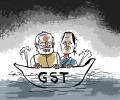
The Centre managed to collect only Rs 990 crore as compensation cess in April 2020-21, almost one-ninth of the figure of Rs 8,874 crore mopped up a year ago. The subdued collection would further increase states' problems unless the GST Council, which meets next week, decides to borrow from the market.

The Council also discussed process to make return filing simpler with just one return to be filed every month.
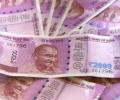
With recent rate cuts, November collections could be even less

The CBIC has come out with guidelines on blocking of tax credit by GST field officers, saying that such blocking should be on the basis of 'material evidence' and not just out of 'suspicion'. The guidelines laid down five specific circumstances in which such credit could be blocked by a senior tax officer. These include availment of credit without any invoice or any valid document, or availing of credit by purchasers on invoices on which GST has not been paid by sellers.

'Challenge is basically near-term growth as the outlook has turned a bit adverse.'

Here's everything you need to know about the Goods and Services Tax Bill.

The central government is likely to exceed the budgeted tax collection target of Rs 22.2 trillion for the current fiscal year, led by better indirect tax mop-up, compliance measures, and recovery in most sectors following the second wave of the Covid pandemic. Personal income and corporate tax collections (net of refunds) grew 74 per cent to Rs 5.70 trillion in the first half of the current financial year, driven mainly by advance tax and TDS payments. The target for the current fiscal year is Rs 11.08 trillion; higher taxes are paid usually towards the end of a fiscal year.

On Thursday, the Business Advisory Committee of the Lok Sabha, which allocates time for the Bills and discussions to be taken up for the forthcoming week, met, but the government strategists didn't ask the members to allocate time for the GST Bills for the next week.

For every rupee in the government coffer, the biggest pie of 63 paise will come from direct and indirect taxes, according to the Union Budget 2024-25 documents.

"To begin with, people could face some difficulties because any changeover has its own problems. But it will settle down and the country will benefit from the new indirect tax regime," Jaitley said at an event organised by ABP News.
Industry body CII has pitched for a reduction in personal income tax rates, decriminalisation of the goods and services tax and a relook at the capital gains tax rates as part of its agenda presented to the government for the forthcoming Budget. Arguing that the GST law already contains adequate penal provisions for deterrence against evasion of taxes, CII has suggested decriminalisation of GST law. Also, the applicability of prosecution provisions should not be based on the absolute amount of tax evasion but should be based on real intent to evade the taxes and a certain percentage of the tax payable, it stated.

No mention of cab aggregators in GST bills

While Congress and the states ruled by non-NDA parties pushed for the Centre meeting its statutory obligation of covering the deficit, the Union government cited a legal opinion to say it had no such obligation if there was a shortfall in tax collections. The Centre as well as BJP-JD-U-ruled Bihar were of the opinion that the states should borrow to make up for the shortfall in the tax revenues that have been compounded by the COVID-19 crisis, sources said.
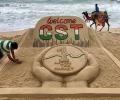
Goods and Services Tax (GST) collections jumped to over Rs 1.31 lakh crore in November, the second highest since its implementation in July 2017, in line with the trend in economic recovery, the finance ministry said on Wednesday. "The gross GST revenue collected in the month of November 2021 is Rs 1,31,526 crore of which CGST is Rs 23,978 crore, SGST is Rs 31,127 crore, IGST is Rs 66,815 crore (including Rs 32,165 crore collected on import of goods) and Cess is Rs 9,606 crore (including Rs 653 crore collected on import of goods)," the ministry said in a statement. CGST refers to Central Goods and Services Tax, SGST (State Goods and Service Tax) and IGST (Integrated Goods and Services Tax).
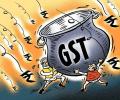
The CAG has found that the Union government in the very first two years of the GST implementation wrongly retained Rs 47,272 crore of GST compensation cess that was meant to be used specifically to compensate states for loss of revenue.

Ironically, West Bengal, which has been seeking a postponement of the GST roll-out, has fared better among most other states.

The data primarily pertains to activities in March, which had only a few days under the Covid-19 lockdown. For April , hence, CGST collections could be much lower, fear analysts.

However, where the directors' remuneration is in the nature of professional fees and not salary, GST will be levied on a reverse charge basis.

Notwithstanding protests by the opposition Bharatiya Janata Party, he said the first session of the newly elected Jammu and Kashmir Assembly is "short in duration but historic in terms of agenda".

Amid an outcry over record high petrol and diesel prices, Union Finance Minister Nirmala Sitharaman on Saturday said the Centre and state governments will have to together work out a mechanism to bring retail rates to reasonable levels.
Under the GST law, states were guaranteed to be paid for any loss of revenue in the first five years of the GST implementation from July 1, 2017.
India's Goods and Services Tax (GST) collection surged to Rs 1.30 lakh crore in October, the second highest since its implementation in July 2017, indicating economic recovery from the COVID-19 pandemic and impact of festive demand, a finance ministry statement said on Monday. The highest GST collection of Rs 1.41 lakh crore was recorded in April 2021. This is the fourth time in a row when the GST collection was upwards of Rs 1 lakh crore. The collection from GST was Rs 1.17 lakh crore in September, 2021.

The Goods and Services Tax (GST) Council, chaired by Union Finance Minister Nirmala Sitharaman, will likely consider on Saturday a GST rate cut for Covid-19 relief essentials and drugs for treating the black fungus disease and might leave the vaccines untouched. The meeting is being held following a report submitted by a Group of Ministers (GoM) to the GST Council on Monday. The GoM, set up by the Council on May 28, was mandated to look at tax exemption and concessions on various Covid items including vaccines, drugs, and equipment.
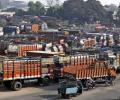
A slew of challenges that are yet to be resolved include the lack of consensus between the Centre and states over the GST exemption threshold limit, dual control over scrutiny and assessment
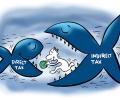
With the implementation of the goods and services tax less than 75 days away -- assuming July 1 as the roll-out date -- Sudipto Dey provides a guide to how businesses can navigate the transition.

Headline growth was quite weak heading into the Covid period but averaged 6.4 per cent and 6.7 per cent in the five years between FY16 and FY20 for GVA and GDP respectively, points out Abhishek Upadhyay.

'GST is imperative for India's success.' 'Without GST India will be a less competitive country.'

In the video, Bachchan explains GST as an unifying force just like the three colours in the national flag.

Mahindra & Mahindra on Friday said it has been imposed a penalty of Rs 4.12 crore over input tax credit claim and education cess credit balance carry forward from pre-GST regime to GST regime in relation to its two-wheeler business. In a regulatory filing, Mahindra & Mahindra said it has received an order from the office of the Deputy Commissioner, State Tax, Audit Wing, Indore-01, Madhya Pradesh imposing a penalty amounting to Rs 4,11,50,120 to the two-wheeler business of Mahindra Two Wheelers Ltd (MTWL), which was demerged from MTWL and has since been merged with the company.

Reaching a consensus might also get tougher, as already seen with issues like inclusion of natural gas in GST and imposition of a sugar cess, both central proposals being resisted.
The instruction is that audit of large units be completed within seven working days, of medium units in five working days and of small ones in three.
To improve compliance, govt may introduce lottery reward for filing GST. The Consumer Welfare Fund, where anti-profiteering proceeds are deposited, will be used to reward the lucky winners on monthly and annual bases. The prize money, yet to be fixed, may run into several lakhs of rupees for the annual draw, and about Rs 50,000 for monthly draws.

All eyes will be on whether Sitharaman provides the much-expected tax relief for the middle class, leaving more money in their hands, as there is tax buoyancy
Experts said the rate hike would improve working capital position of the manufactures as it would correct the inverted duty structure but may lead to increase in price of the finished goods.

As corporate India gears up to be GST-ready, the ongoing litigation and tax dispute cases are something most businesses are cagey about.

Steep taxes on petrol and diesel add to the cost of economic activity and reduce the Indian economy's competitiveness. The two fuels must be brought under GST's purview, suggests former IAS officer Ajay Shankar.
